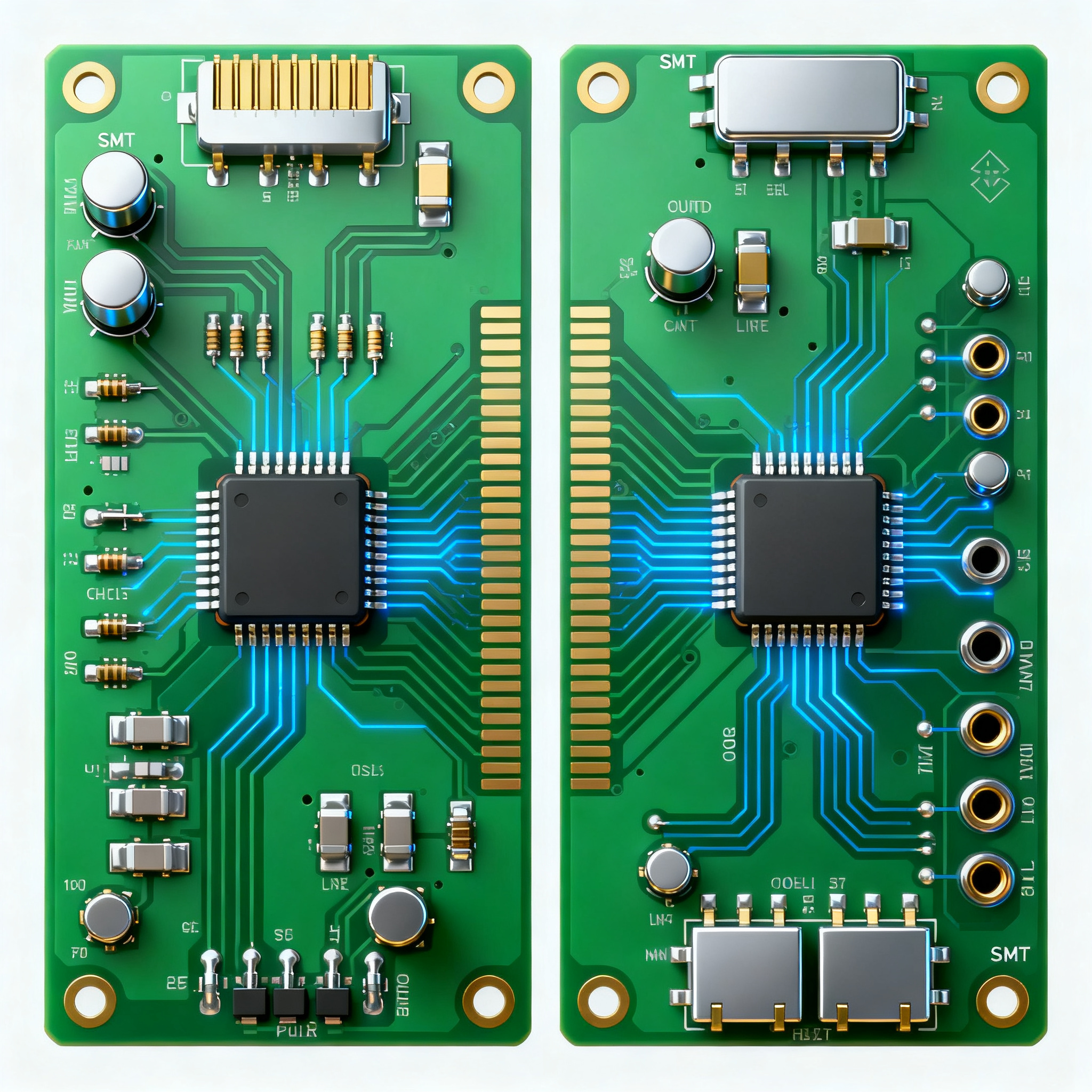
SMT Assembly vs. Through-Hole: A Detailed Comparison for High-Frequency Applications
SMT Assembly vs. Through-Hole for High-Frequency Applications body { font-family: Arial, sans-serif; line-height: 1.6; margin: 20px; } h2 { color: #333; } table { border: 1px solid #ccc; border-collap...
Introduction
In the rapidly evolving field of electronics, the choice between Surface Mount Technology (SMT) and Through-Hole Technology (THT) for high-frequency applications is critical. Each method has unique advantages and challenges that influence the performance, cost, and manufacturability of electronic devices. This article provides a detailed comparison of SMT and THT, particularly focusing on their application in high-frequency circuits, highlighting core specifications, electrical characteristics, and practical applications.
Technical Overview
Surface Mount Technology (SMT) and Through-Hole Technology (THT) are two primary methods for mounting components on printed circuit boards (PCBs). SMT involves placing components directly onto the surface of PCBs, allowing for more compact designs, higher circuit densities, and automated assembly processes. Conversely, THT involves inserting leads of components through pre-drilled holes on the PCB, providing strong mechanical bonds and better heat dissipation, which can be advantageous in high-power applications.
For high-frequency applications, factors such as signal integrity, parasitic inductance, and capacitance become crucial. SMT components, due to their smaller size and reduced lead lengths, typically offer lower parasitic effects and better high-frequency performance. However, THT components can provide superior thermal management and mechanical stability, which are critical in certain high-power, high-frequency scenarios.
Detailed Specifications
When selecting components for high-frequency applications, several specifications are pivotal. These include CPU speed, memory, available peripherals, power requirements, and package type. The following table outlines core specifications for typical IC components used in these applications.
| Specification | SMT IC | THT IC |
|---|---|---|
| CPU Speed | 1 GHz | 800 MHz |
| Memory | 512 KB Flash, 128 KB RAM | 256 KB Flash, 64 KB RAM |
| Peripherals | USB, I²C, SPI | UART, CAN |
| Power Supply | 3.3V | 5V |
| Package Type | QFN | DIP |
| Operating Temperature | -40 to 85°C | -20 to 70°C |
| Footprint | 10x10 mm | 25x25 mm |
| Cost | $2.50 | $3.00 |
| Availability | High | Moderate |
| Lifecycle | 5 years | 7 years |
Key Takeaways from the Specifications
The specifications highlight that SMT ICs generally offer higher CPU speeds and more integrated peripherals, which are advantageous for high-frequency applications requiring rapid data processing and communication. The smaller package size of SMT components supports higher circuit densities, essential for compact designs. In contrast, THT components, with their larger package and higher power supply voltage, are better suited for applications where mechanical robustness and power handling are prioritized. The choice between SMT and THT will depend on specific application requirements, including space constraints, environmental conditions, and cost considerations.
| Electrical Characteristic | SMT IC | THT IC |
|---|---|---|
| Voltage Range | 1.8V - 3.6V | 3.3V - 5.5V |
| Current Consumption | 50 mA | 100 mA |
| Input/Output Pins | 24 | 16 |
| Signal Rise Time | 5 ns | 10 ns |
| Signal Fall Time | 6 ns | 12 ns |
| Output Drive Strength | 20 mA | 25 mA |
| Thermal Resistance | 30°C/W | 40°C/W |
| ESD Protection | ±2 kV | ±4 kV |
| Noise Immunity | High | Moderate |
| Frequency Range | Up to 2 GHz | Up to 1 GHz |
| Parasitic Capacitance | 0.5 pF | 1.0 pF |
Practical Implications
The electrical characteristics table indicates that SMT components generally have lower current consumption and better high-frequency performance due to reduced parasitic capacitance and lower thermal resistance. These attributes make SMT ideal for compact, high-speed applications where energy efficiency and signal integrity are crucial. THT components, with their higher voltage range and output drive strength, are better suited for robust, high-power environments. Designers must weigh these factors based on the application's electrical demands and thermal management needs.
| Application | SMT Suitability | THT Suitability |
|---|---|---|
| Consumer Electronics | High | Low |
| Automotive Systems | Medium | High |
| Industrial Control | Medium | High |
| Telecommunications | High | Low |
| Medical Devices | High | Medium |
| Aerospace | Medium | High |
| Power Electronics | Low | High |
Application Guidelines
When selecting between SMT and THT for high-frequency applications, the application context plays a crucial role. SMT is highly suitable for consumer electronics and telecommunications, where space efficiency and high-speed communication are priorities. THT, however, excels in automotive, industrial, and aerospace applications that demand durability and reliability in harsh environments. Understanding the specific requirements of the application, including environmental conditions, space constraints, and performance needs, is essential for choosing the appropriate technology.
Design Considerations
Designing for high-frequency applications requires careful consideration of several factors to ensure optimal performance. Key considerations include:
- Signal Integrity: Minimize parasitic inductance and capacitance by optimizing trace lengths and using appropriate grounding techniques.
- Thermal Management: Implement adequate heat dissipation strategies, such as heat sinks or thermal vias, especially for high-power components.
- Component Placement: Place components strategically to minimize electromagnetic interference (EMI) and enhance signal integrity.
- PCB Material: Select materials with suitable dielectric properties to support high-frequency signals.
- Power Distribution: Ensure stable power supply by using decoupling capacitors and proper power routing.
- Compliance with Standards: Adhere to industry standards, such as IPC-A-610 and IPC-2221, to ensure quality and reliability.
By addressing these design considerations, engineers can optimize circuit performance, reduce noise, and enhance the reliability of high-frequency applications.
Step-by-Step Implementation
- Define Requirements: Clearly outline the application requirements, including frequency range, power consumption, and environmental conditions.
- Select Components: Choose suitable SMT or THT components based on the defined requirements and consult datasheets for detailed specifications.
- Design Schematic: Create a schematic diagram that incorporates all necessary components and connections, ensuring signal integrity and power stability.
- Layout PCB: Design the PCB layout, focusing on minimizing trace lengths and optimizing component placement for high-frequency performance.
- Prototype Development: Develop a prototype to test the design under real-world conditions and identify potential issues.
- Testing and Validation: Conduct thorough testing to validate performance against specifications, focusing on signal integrity, thermal management, and EMI.
- Iterate and Optimize: Make necessary adjustments to the design based on testing results to optimize performance and reliability.
- Finalize Design: Once validated, finalize the design for mass production, ensuring compliance with relevant standards and regulations.
This step-by-step approach ensures a systematic and thorough development process, leading to high-performance, reliable high-frequency applications.
Common Issues & Solutions
- Signal Integrity Loss: Use differential signaling and proper grounding techniques to minimize parasitic effects.
- Thermal Overheating: Incorporate heat sinks and optimize thermal paths to manage heat dissipation effectively.
- EMI Interference: Implement shielding and maintain proper spacing between components to reduce EMI.
- Component Mismatch: Verify component compatibility and ensure accurate placement to avoid mismatches and connectivity issues.
- Power Supply Instability: Use decoupling capacitors and robust power routing to ensure stable power distribution.
- Manufacturing Defects: Collaborate with reliable manufacturers and perform quality inspections to minimize defects.
Addressing these common issues with proactive solutions ensures the reliability and performance of high-frequency applications.
Applications & Use Cases
High-frequency applications span various industries, each with unique requirements and challenges. In consumer electronics, SMT components enable compact designs and efficient high-speed communication. Automotive systems benefit from THT components due to their robustness and reliability in harsh environments. In telecommunications, SMT supports the miniaturization of devices and efficient signal processing. Understanding these use cases helps engineers choose the right technology based on application needs.
Selection & Sourcing Guide
Selecting and sourcing the right components is crucial for successful high-frequency applications. Utilize resources such as IC Online for comprehensive component datasheets, availability, and pricing. Consider factors like lead time, manufacturer reputation, and compliance with industry standards when sourcing components to ensure quality and reliability.
FAQ
- What are the advantages of SMT over THT? SMT offers higher circuit densities, automated assembly, and better high-frequency performance due to reduced parasitic effects.
- When should I choose THT over SMT? THT is preferable in applications requiring mechanical robustness and superior heat dissipation, such as automotive and industrial systems.
- How does parasitic capacitance affect high-frequency performance? Parasitic capacitance can degrade signal integrity by introducing unwanted noise and reducing bandwidth, particularly in high-frequency applications.
- What role does PCB material play in high-frequency applications? PCB material affects signal integrity and dielectric properties, influencing the overall performance of high-frequency circuits.
- How can I minimize EMI in my design? Implement shielding, maintain proper component spacing, and use differential signaling to reduce EMI in high-frequency designs.
- What are the key considerations for thermal management? Use heat sinks, thermal vias, and optimize component placement to manage heat dissipation effectively.
- How do I ensure compliance with industry standards? Follow IPC standards and collaborate with reliable manufacturers to ensure compliance and quality.
- What testing methods are essential for high-frequency applications? Conduct signal integrity, thermal, and EMI testing to validate performance against specifications.
- How do I optimize power distribution in my design? Use decoupling capacitors and robust power routing to ensure stable power distribution and minimize voltage fluctuations.
- What are the common challenges in high-frequency applications? Common challenges include signal integrity loss, thermal overheating, and EMI interference, which can be addressed with proactive design strategies.
Conclusion
The choice between SMT and THT for high-frequency applications depends on specific requirements, including performance, cost, and environmental conditions. SMT offers advantages in compactness and high-frequency performance, while THT provides robustness and reliability in demanding environments. By understanding the strengths and limitations of each technology, engineers can make informed decisions that optimize the performance and reliability of their high-frequency applications.