PLC I/O Module PCB Assembly
Ensure reliable industrial automation with our precision PLC I/O Module PCB Assembly services. We deliver high-performance, rugged boards designed for seamless signal processing and control in demanding environments, backed by rigorous testing and fast turnaround.
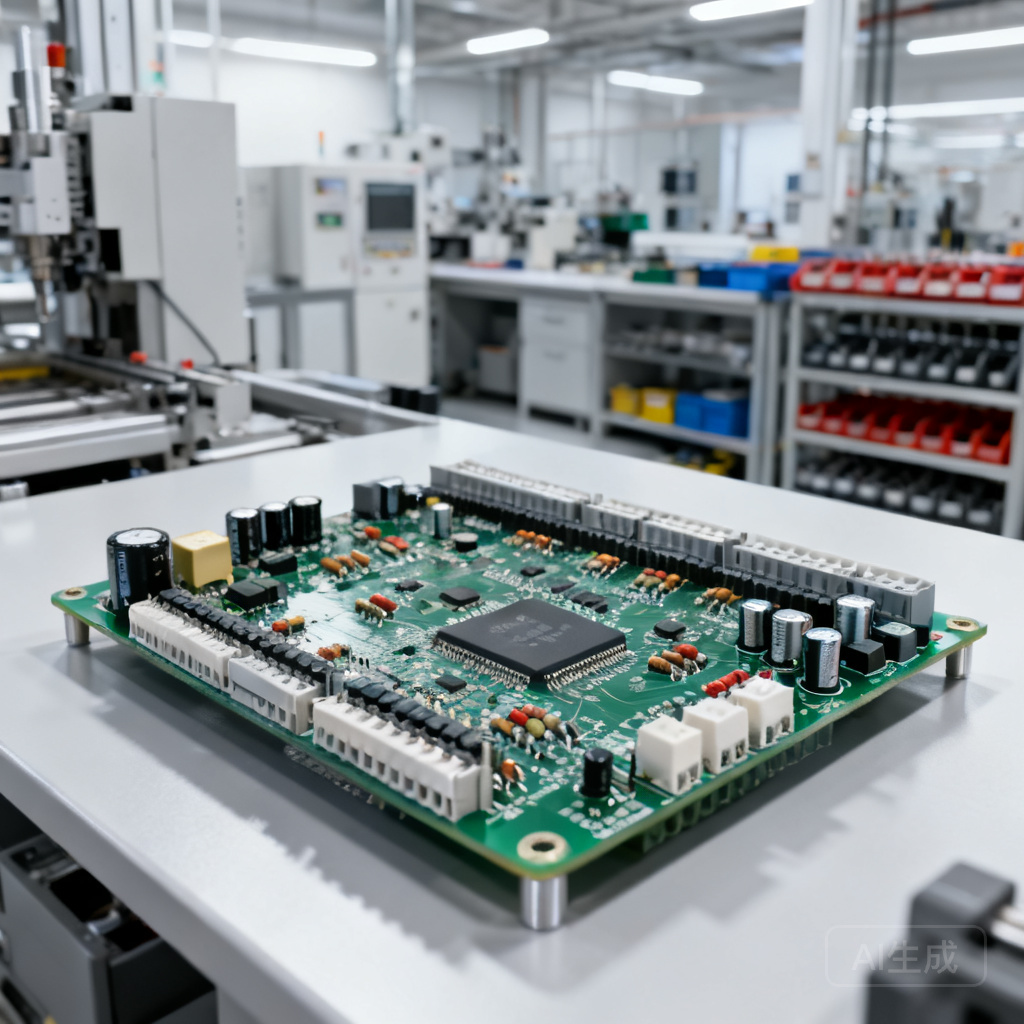
Overview
PLC I/O Module PCB Assembly — NovaPCBA's Specialized Service
\nWhen a PLC I/O module fails, the cost is rarely just a replacement board—it's unscheduled downtime on a packaging line, a water treatment plant, or a power distribution network. The root cause often traces to PCB assembly defects: cold solder joints, via cracking, and laminate contamination (Matric). Remediation is slow and expensive, involving forensic analysis and line stoppages (Matric). NovaPCBA eliminates these risks by assembling every PLC I/O module to IPC-A-610 Class 2/3 standards, delivering field‑ready boards that keep industrial systems running.
\n\nWhat's Included in Our PLC I/O Module PCB Assembly Service
\n- \n
- SMT + Through‑Hole Hybrid Assembly: Mixed‑technology placement for dense digital logic and high‑current output relays/connectors, with automated optical inspection (AOI) after every stage. \n
- Controlled Impedance Routing: Precise stack‑up and trace geometry for Ethernet/IP, Profinet, and backplane communication interfaces, verified by TDR testing. \n
- Thermal Management for High‑Current Channels: Heavy copper (up to 6 oz), thermal vias, and metal‑core substrates to dissipate heat from 2‑10 A output drivers without board degradation. \n
- Full BOM Traceability: Every component is lot‑tracked from incoming inspection to final test, with Certificates of Conformance (CoC) supplied for each shipment. \n
- Conformal Coating & Potting: Parylene, acrylic, or silicone coatings protect against moisture, dust, and corrosive gases in harsh industrial environments. \n
Industries & Applications
\nPLC I/O modules demand extreme reliability because they interface directly with sensors, actuators, and high‑voltage machinery. NovaPCBA serves:
\n- \n
- Factory Automation: Distributed I/O blocks and PLC racks for automotive assembly lines, where vibration and thermal cycling demand Class 3 solder joints. \n
- Process Control: Oil & gas, chemical, and water treatment plants requiring intrinsically safe barrier boards and long‑term corrosion resistance. \n
- Energy & Utilities: Substation RTUs and grid automation modules that must operate 24/7 for decades without field rework. \n
- Transportation: Railway signaling and onboard control systems needing shock‑ and vibration‑proof assemblies compliant with EN 50155. \n
Comparison: In‑House Assembly vs Offshore‑Only vs Turnkey
\n| Factor | In‑House Assembly | Offshore‑Only | NovaPCBA Turnkey |
|---|---|---|---|
| Lead Time | \n8–14 weeks (tooling & setup) | \n10–16 weeks (logistics, customs, rework loops) | \nPrototypes: 5–10 days Production: 2–4 weeks | \n
| Defect Catch | \nRelies on internal QA; often misses latent defects | \nVariable; limited feedback loop increases escapes | \nAOI at 3 stages + X‑ray + ICT; Class 2/3 criteria enforced | \n
| Cost Driver | \nHigh fixed overhead, idle capacity | \nLow unit price, but high rework, scrap, and expediting costs | \nDFM‑optimized BOM, zero‑rework flow, no hidden logistics | \n
| Failure Boundary | \nOwnership of field failures; slow root‑cause analysis | \nLanguage/time‑zone barriers; warranty disputes | \nSingle‑source accountability; failure analysis and corrective action within days | \n
Sources: EMS evaluation criteria (TPS Elektronik), turnkey BOM management (Hdicircuitboard).
\n\nOur Manufacturing Process
\n- \n
- DFM & Gerber Review: Our engineers analyze your design for manufacturability, referencing PLC‑specific guidelines—clearance for high‑voltage I/O, thermal relief, and test point access. \n
- SMT Assembly: Automated solder paste printing, 3D SPI, high‑speed pick‑and‑place, and 10‑zone reflow. AOI inspects every joint pre‑ and post‑reflow. \n
- Through‑Hole & Selective Soldering: Heavy connectors, relays, and transformers are inserted and soldered with selective wave or robotic soldering to avoid thermal shock to SMD parts. \n
- Testing & Coating: In‑circuit test (ICT) verifies component values; functional test simulates I/O loads and communication. Boards then receive conformal coating and final AOI before packaging. \n
Quality Assurance
\nNovaPCBA builds every PLC I/O module to IPC‑A‑610 Class 2 or Class 3 acceptance standards, as appropriate for the application’s criticality (DigiSource). Our multi‑stage inspection chain prevents the exact defects that cause field failures:
\n- \n
- 3D Solder Paste Inspection (SPI): Catches insufficient paste, bridging, or misalignment before components are placed—eliminating the #1 root cause of intermittent opens. \n
- Pre‑Reflow & Post‑Reflow AOI: Identifies missing components, tombstoning, and lifted leads with high‑resolution cameras; any suspect board is quarantined immediately. \n
- X‑ray Inspection: Validates BGA, QFN, and hidden solder joints for voiding and wetting, critical for high‑density communication processors. \n
- In‑Circuit & Functional Test: ICT checks every net for shorts/opens; functional test drives I/O channels at rated current and voltage, simulating real‑world loads. Only boards passing all stages are shipped. \n
This layered approach aligns with the IPC assembly standards and our ISO9001‑certified quality management system. RoHS compliance is standard; leaded processes are available for exempt applications.
\n\nFrequently Asked Questions
\n- \n
- Q: Can we audit your facility before placing a PLC I/O module order? \n
- A: Absolutely. We welcome on‑site audits and provide a detailed quality plan, process flow documentation, and equipment list. Virtual audits with live video walkthroughs are also available. Our ISO9001 certification and IPC‑A‑610 workmanship samples are open for review. \n
- Q: Do you provide full traceability and Certificates of Conformance (CoC) for each batch? \n
- A: Yes. Every reel, tube, and tray is scanned into our MES at intake. Lot codes are tracked through SMT, through‑hole, test, and coating. You receive a CoC and a traceability report linking each board serial number to its component date codes and process parameters. \n
- Q: What is the typical lead time for PLC I/O Module PCB Assembly? \n
- A: Functional prototypes (5–50 pieces) are delivered in 5–10 business days after BOM and Gerber approval. Production volumes (500–10k+) ship in 2–4 weeks, depending on complexity and coating requirements. We offer expedited 72‑hour turns for critical spares. \n
Get a Quote for PLC I/O Module PCB Assembly
\nSend your Gerber files, BOM, and any test specifications to our engineering team. We’ll return a comprehensive DFM report and a firm quotation within 24 hours. Whether you need 10 prototypes or 10,000 production units, NovaPCBA delivers PLC I/O modules that meet the toughest industrial demands. Learn more about our turnkey approach and start your project today.
\n\nReferences & Further Reading
\n- \n
- 6 Common Causes of PCB Failure: What OEMs Should Know – Matric \n
- PCBA Failure Analysis: Circuit Board Defects & Remedies – FS Tech \n
- What to Do About PCB Failure – Matric \n
- 3 Most Common PCB Assembly Defects – DigiSource \n
- PLC PCB Manufacturing: Industrial Control Systems Design Guide – HilPCB \n
- PCB Assembly Services EMS: A Technical Guide – TPS Elektronik \n
- PCB Assembly Standards | Assembly Guide & Requirements – WellPCB \n
- PCB Assembly Services for Engineers – Hdicircuitboard \n