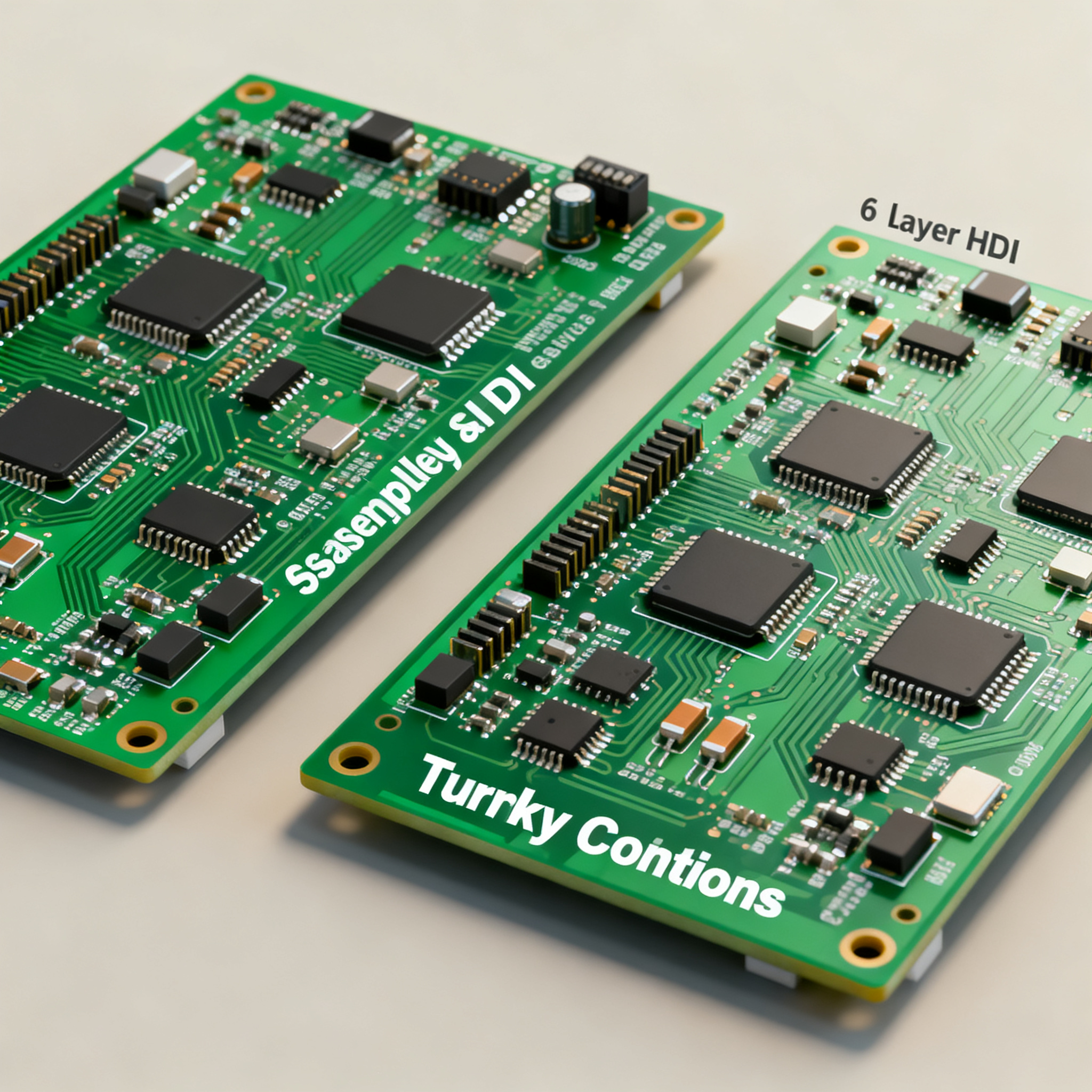
Turnkey vs. Consigned PCB Assembly Service for 6-Layer HDI Boards: A Selection Guide
When a 6‑Layer HDI Board Puts Your Supply Chain to the Test A 6‑layer HDI board with 0.5 mm pitch BGAs does not politely wait for you to sort out your supply chain. It exposes every weakness the momen...
When a 6‑Layer HDI Board Puts Your Supply Chain to the Test
A 6‑layer HDI board with 0.5 mm pitch BGAs does not politely wait for you to sort out your supply chain. It exposes every weakness the moment your BOM leaves your desk. You might have spent weeks tuning the stackup — blind vias on layers 1–2 and 5–6, buried vias connecting layers 2–5, controlled impedance on the high‑speed differential pairs — but none of that matters if the assembly model you choose cannot deliver the right components, in the right condition, at the right time.
The conversation around turnkey versus consigned assembly has grown louder over the past year, and for good reason. On the DigiKey TechForum, engineers have been openly debating which model "feels safer" in the current climate. One contributor noted that "for U.S.‑based builds, I've noticed some customers prefer full turnkey sourcing to reduce risk, while others still supply their own parts to control cost" [DigiKey TechForum]. That tension is not theoretical — it plays out on every dense HDI project that crosses a purchasing manager's desk.
The core of the debate is ownership. In a full turnkey model, the assembly partner owns sourcing, fabrication, assembly, and testing. As RapidDirect frames it, "you do not chase a PCB shop for boards, a distributor for parts, and an assembly house for soldering" [RapidDirect]. With consigned assembly, that burden — and the accountability that comes with it — stays with you. For a board that packs 200+ components across six layers, including at least one fine‑pitch BGA and a handful of long‑lead connectors, the choice is rarely obvious.
What makes 6‑layer HDI particularly unforgiving is the density multiplier. A standard 4‑layer through‑hole board can forgive a mis‑managed component kit with a few extra rework cycles. A 6‑layer HDI stack with laser‑drilled microvias cannot. Rework on a blind via pad is delicate, expensive, and sometimes impossible without scrapping the entire board. When a 0.5 mm BGA sits on top of that stack, the margin for error shrinks to near zero. The assembly model you pick does not just affect your invoice — it directly shapes your first‑pass yield, your rework budget, and whether your prototype spins on schedule or stalls for eight weeks waiting for a single out‑of‑stock connector.
Tip: Before you even request a quote, walk your BOM through both scenarios. If you cannot confidently source every line item within a two‑week window, a pure consigned model is already carrying hidden schedule risk.
The real question is not which model is cheaper on a per‑unit basis. It is which model gives you the highest probability of a functional board arriving on your lab bench when you need it — and at a total project cost you can defend to your finance team. The sections that follow unpack that question layer by layer, using real assembly workflows, documented trade‑offs, and the specific constraints that 6‑layer HDI boards impose.
The Component Flow: How Turnkey and Consigned Models Manage BOMs, BGAs, and Blind Vias
Understanding the assembly model options starts with mapping who owns what — and when they own it. On a 6‑layer HDI board, the component flow is not a simple purchase order. It is a choreographed sequence of sourcing, kitting, stencil design, placement, reflow, and inspection, all of which must account for the mechanical fragility of microvias and the thermal sensitivity of fine‑pitch BGAs.
Three models dominate the landscape: full turnkey, partial turnkey, and consigned. Each distributes responsibility differently across the BOM, and each carries distinct implications for lead time, cost structure, and quality risk. The table below breaks down the mechanics.
| Parameter | Full Turnkey | Partial Turnkey | Consigned |
|---|---|---|---|
| BOM ownership | EMS owns sourcing and inventory | Customer supplies select line items; EMS handles remainder | Customer owns all components |
| Sourcing responsibility | EMS manages all supplier relationships | Split: customer handles long‑lead or proprietary parts | Customer manages all procurement |
| Excess parts handling | EMS calculates and stocks overage; typically 3–5% built into quote | Customer supplies overage for consigned portions; EMS for turnkey portions | Customer must supply 3–5% overage on passives, ≥1 extra per fine‑pitch IC |
| Lead‑time dynamics | EMS absorbs component lead‑time variability; single point of accountability | Customer lead‑time for supplied parts must align with EMS assembly schedule | All lead‑time risk sits with customer; one late line item stalls the entire build |
| Component verification | EMS performs incoming inspection, authenticity checks, and MSL handling | EMS verifies turnkey portions; customer is responsible for consigned portion integrity | Customer performs all verification; EMS may charge for re‑inspection if parts arrive damaged |
| Counterfeit risk | Transferred to EMS; reputable shops use authorized distributors | Shared: customer assumes risk on supplied parts | Fully retained by customer |
| Stencil / reflow optimization | EMS owns the full process; can adjust stencil aperture and reflow profile for the entire BOM | EMS optimizes around known turnkey parts; customer‑supplied parts may require separate profile validation | Customer must provide complete data; EMS follows customer‑specified profiles with limited adjustment |
| Typical fit | Prototypes, low‑to‑medium volume, teams without in‑house procurement | Mixed BOMs with specialty connectors, programmed ICs, or proprietary sensors | High‑volume production with mature supply chains; OEMs with dedicated component engineering teams |
A practical example anchors these abstractions. Hdicircuitboard documented a turnkey PCBA project for a compact industrial sensor gateway built on a 6‑layer PCB. The board carried a 0.5 mm BGA microcontroller, a wireless module, a USB‑C connector, two terminal blocks, a relay, LEDs, and a 24 V input power stage [Hdicircuitboard]. Under a consigned model, the customer would have needed to source and kit every one of those line items — including the BGA, which demands moisture‑sensitivity level (MSL) handling, and the USB‑C connector, which can have 12‑week lead times from certain franchised distributors. Under full turnkey, the EMS absorbed that complexity, applied its negotiated component pricing, and delivered assembled boards with a single invoice.
The BOM checklist logic from PCBnet reinforces why sourcing‑ready data matters regardless of model. "For turnkey PCB assembly, the assembler needs sourcing‑ready data so they can check component availability, lead times, pricing, and substitution options. For consignment PCB assembly, the BOM needs to show which parts the customer will provide and whether enough excess parts are included for setup, handling, and possible attrition" [PCBnet]. A BOM that lists "CAP, 0.1 µF, 0402" without a manufacturer part number (MPN) is useless to a turnkey EMS and dangerous to a consigned build. The same checklist applies with greater urgency to 6‑layer HDI because every placement error on a microvia pad risks board scrap.
NextPCB explicitly supports all three models — full turnkey, partial turnkey, and full consignment — giving engineers the flexibility to shift responsibility as their project matures [NextPCB]. That flexibility becomes important when you are prototyping a 6‑layer HDI design and are not yet sure which specialty connectors will survive the next design revision.
Key Takeaway: Full turnkey shifts sourcing risk and component verification to the EMS. Consigned keeps control — and accountability — in your hands. Partial turnkey sits in the middle, and that middle ground can be deceptively expensive to manage if you underestimate the coordination burden.
Side‑by‑Side: Turnkey and Consigned Trade‑offs When 6 Layers Meet 0.5 mm Pitch BGAs
Choosing an assembly model for a standard 2‑ or 4‑layer board is often a question of convenience. For a 6‑layer HDI board with 0.5 mm pitch BGAs, it becomes a question of physics. The placement accuracy required for a 0.5 mm pitch BGA — typically ±25 µm or better — leaves no room for component handling errors, oxidized terminations, or stencil designs that were not co‑optimized with the pad geometry. The model you choose determines whether the party running the pick‑and‑place machine also had skin in the game when the components arrived at the loading bay.
The comparison table below isolates five dimensions where turnkey and consigned models diverge meaningfully for HDI boards. Each row connects to documented service capabilities or industry observations.
| Comparison Metric | Full Turnkey | Consigned Assembly | Selection Criteria & Failure Boundary |
|---|---|---|---|
| Cost structure (total project) | Unit price appears higher; total cost often lower after bulk component pricing and reduced internal procurement hours. Elepcb notes turnkey can be "more cost‑effective overall due to the manufacturer's bulk purchasing power" [Elepcb]. | Lower quoted unit price; hidden costs in procurement man‑hours, scrap from mis‑managed kits, and expedited re‑orders for missing parts. | Run a total cost of ownership (TCO) analysis on your actual BOM. If internal procurement costs exceed 15% of the BOM value, turnkey likely wins on TCO. |
| Quality risk on 0.5 mm BGA | EMS controls stencil design, solder paste selection, and reflow profiling as a unified process. Any component authenticity issue is caught before placement. | Customer bears quality risk on supplied components. A single counterfeit or moisture‑damaged BGA can cause bridging or head‑in‑pillow defects that are invisible until X‑ray inspection. | If you lack in‑house component inspection capability (XRF, decapsulation, or at minimum a trusted authorized distributor chain), consigned exposes you to undetected defects. |
| Control over specialty parts | You surrender sourcing control. The EMS may substitute an alternate MPN if your specified part is unavailable, requiring your approval — but the clock is ticking. | You maintain full control over every line item. For proprietary sensors, pre‑programmed MCUs, or safety‑rated connectors, this control can be non‑negotiable. | If your BOM contains ≥3 sole‑source or customer‑specific parts, partial turnkey or consigned is likely the safer starting point. |
| Prototype‑to‑production scalability | Seamless: the EMS already owns the sourcing pipeline. Ramp‑up is a matter of scheduling production slots. PCBONLINE explicitly supports HDI, multilayer, and rigid‑flex within their turnkey framework [PCBONLINE]. | Requires you to scale your own component pipeline. What worked for a 10‑board prototype kit may break at 1,000 units when distributor allocation limits hit. | If you plan to scale beyond 500 units within 12 months, evaluate whether your internal supply chain has the allocation agreements to support that volume. |
| Rework accountability | EMS owns rework costs if the root cause traces to sourcing or process. Single throat to choke. | Fault isolation becomes adversarial: was it your component, your handling, or their process? Rework on blind vias is expensive enough without a dispute over who pays. | On 6‑layer HDI, rework on a buried via can cost more than the original assembly. Clarify accountability terms in the contract before placing the PO. |
The Hdicircuitboard sensor gateway example [Hdicircuitboard] illustrates how these trade‑offs compound on a real board. That design combined a 0.5 mm BGA with a wireless module, terminal blocks, and a power stage — a mixed‑signal environment where grounding and isolation matter. Under consigned assembly, the customer would need to verify that every passive in the power stage met the voltage rating and temperature coefficient specified in the design, not just a "close enough" substitute from a broker. Under turnkey, that verification becomes the EMS's responsibility, backed by their distributor relationships and incoming inspection protocols.
Note: The quality risk differential is not theoretical. A 6‑layer HDI board with laser‑drilled microvias has via‑in‑pad structures that are mechanically weaker than through‑hole vias. A single rework cycle on a BGA pad connected to a blind via can lift the pad, destroying the board. The cost of that failure — in both dollars and schedule — often dwarfs any per‑unit savings from a consigned approach.
NextPCB's HDI manufacturing capabilities extend to Class 3 HDI and any‑layer constructions, supporting the kind of dense routing that 0.5 mm BGAs demand [NextPCB HDI]. When an EMS routinely fabricates and assembles 6‑layer HDI stacks, their process engineers already understand the interaction between the PCB fabrication tolerances and the assembly requirements — knowledge that a consigned‑only assembly house may not possess if they are seeing your bare boards for the first time.
Decision Levers: When to Hand Over the BOM vs. Keep Component Control In-House
Abstract comparisons only get you so far. What matters is the moment you sit down with your BOM, your schedule, and your budget, and decide which model to put in front of your manager. The following decision levers translate the trade‑offs into concrete triggers — conditions that, if true, should push you decisively toward one model or the other.
| Decision Trigger | If TRUE, lean toward | Rationale & Action |
|---|---|---|
| Your BOM contains ≥5 line items with lead times >8 weeks | Full or partial turnkey | An EMS with established distributor allocations can often pull in lead times you cannot. RapidDirect's model explicitly bundles fabrication, parts sourcing, and assembly under one roof, eliminating the multi‑vendor coordination delay [RapidDirect]. |
| Your design includes one or more proprietary or customer‑programmed ICs | Partial turnkey or consigned | You do not want an EMS sourcing a microcontroller that you need to flash with proprietary firmware before placement. Supply those parts yourself; let the EMS handle passives, connectors, and commodity ICs. |
| You have no in‑house component engineering or inspection capability | Full turnkey | Without the ability to verify authenticity — XRF for RoHS compliance, visual inspection for remarking, or basic electrical testing — you are gambling. The DigiKey community discussion noted that "some customers prefer full turnkey sourcing to reduce risk" precisely because the EMS absorbs counterfeit risk [DigiKey TechForum]. |
| Your procurement team already manages 20+ active BOMs | Full turnkey | Adding a consigned 6‑layer HDI kit to an already stretched procurement team creates a bottleneck. The hidden cost is not the component price — it is the engineer spending 15 hours a week chasing distributor quotes instead of debugging the next revision. |
| You are prototyping and expect ≥3 BOM revisions before production | Partial turnkey | Full turnkey locks you into the EMS's sourcing pipeline for every revision. Partial turnkey — as supported by NextPCB [NextPCB] — lets you supply the parts that are likely to change (sensors, connectors, programmed ICs) while the EMS handles the stable bulk of the BOM. |
| Your board has buried or blind vias that require sequential lamination | Full turnkey with an HDI‑capable EMS | Fabrication and assembly should not be decoupled on complex HDI. PCBONLINE's turnkey service includes both HDI PCB manufacturing and assembly [PCBONLINE], which means the fab notes on via registration feed directly into the assembly team's stencil alignment strategy. |
Beyond these triggers, there is a subtler consideration that often gets overlooked: the management overhead of partial turnkey. On paper, partial turnkey looks like the best of both worlds — you keep control of the tricky parts, and the EMS handles the commodity bulk. In practice, it means you are now a supply chain coordinator. You must align your connector delivery date with the EMS's kit‑pulling schedule. You must ensure your excess parts arrive with full traceability documentation. You must respond within hours when the EMS flags that your supplied BGA has an MSL label that expired last week. The PCBnet checklist captures this well: consigned BOMs must confirm that "enough excess parts are included for setup, handling, and possible attrition" [PCBnet]. Partial turnkey splits that responsibility, and the split itself consumes management bandwidth.
Tip: If you are leaning toward partial turnkey, assign a single point of contact on your team who owns the interface with the EMS. That person needs authority to approve substitutions, expedite purchase orders, and accept or reject the EMS's incoming inspection reports. Without that clarity, partial turnkey degrades into a blame game the moment a part goes missing.
Questions Engineers and Buyers Ask When Weighing Assembly Models for 6‑Layer HDI
In hundreds of project kickoff meetings, certain questions surface predictably. The answers are rarely binary — they depend on board complexity, volume, and internal capability. What follows addresses six questions that senior engineers and procurement leads consistently raise when evaluating turnkey versus consigned assembly for dense HDI boards.
Q: For a 6‑layer HDI prototype with a 0.5 mm BGA, does turnkey or consigned reduce first‑pass yield risks?
Turnkey almost always lowers first‑pass yield risk on dense HDI prototypes — and the reason comes down to process integration, not component price. When an EMS owns the full supply chain, their engineering team co‑optimizes stencil aperture design, solder paste type, and reflow thermal profile for the specific BGA package and pad geometry on your board. They verify every component before it hits the feeder, catching moisture‑damaged BGAs, oxidized terminations on passives, and out‑of‑tolerance connectors before placement. In a consigned build, that responsibility transfers to you. If your supplied 0.5 mm BGA has been sitting in a humid lab drawer for six months without proper MSL‑4 baking, the assembler may not discover the issue until X‑ray inspection reveals head‑in‑pillow defects — at which point the board is already scrap because reflowing a 6‑layer HDI stack to rework a single BGA risks pad lifting on blind vias. The visible cost difference on the quote does not capture this risk differential; it only surfaces later as yield loss.
Q: How should I handle long‑lead specialty connectors when I want to keep them tight in a partial turnkey model?
Partial turnkey is designed for exactly this scenario: you supply the specialty connectors, and the EMS sources everything else. But the mechanics require discipline. First, place your connector order early enough that the parts arrive at the EMS at least five business days before the scheduled assembly start date — this gives the EMS time to inspect, count, and log them into their kitting system. Second, supply enough excess pieces for setup and attrition. For connectors with 40+ pins, 3–5% overage is standard; for smaller connectors, at least two extra pieces per reel. Third, ensure your connectors arrive with full traceability documentation — manufacturer CoC, date code, and MSL labeling if applicable. The EMS cannot accept parts with unknown provenance without assuming counterfeit liability, and most reputable shops will quarantine undocumented parts until you provide paperwork. Fourth, coordinate your lead‑time explicitly with the EMS's production scheduler. If your connector has a 12‑week lead time and the assembly slot is in 14 weeks, you have margin. If the assembly slot is in 10 weeks, you need to expedite or re‑phase the build.
Q: What excess component percentage should I supply for a consigned 6‑layer HDI board?
The baseline is 3–5% overage on high‑count passives (0402 and 0201 resistors and capacitors, where counts often exceed 100 pieces per value) and at least one extra unit per fine‑pitch IC, BGA, QFN, or specialty connector. For a 6‑layer HDI board, this recommendation is not just about covering pick‑and‑place drop losses. It is about protecting against the unique rework fragility of HDI stacks. If a single 0402 capacitor tombones during reflow and the pad connects to a blind via, the rework technician has exactly one careful attempt to replace it before the via pad risks delamination. Having spare parts on hand means the technician can discard a damaged component immediately rather than attempting a risky salvage. For BGAs, the extra unit also serves as a sentinel: if the first BGA shows bridging or voiding under X‑ray, the assembler can swap in the spare and compare results before suspecting the board or the process.
Q: Can I switch from consigned to turnkey mid‑project if component sourcing becomes a bottleneck?
Possible, but messy — and the mess scales with how far into the project you are. The assembler will need a complete, sourcing‑ready BOM with approved manufacturer part numbers (MPNs) for every line item, not just the ones you have been struggling to source. They may add non‑recurring engineering (NRE) charges for new stencils if the original stencil was cut for a different set of component tolerances, or for reprogramming if the placement data needs updating. More importantly, the EMS will need to re‑validate the entire component kit, which can add two to three weeks to your timeline. If you suspect early in the project that component sourcing could become a bottleneck, a partial turnkey arrangement is a safer hedge. Under partial turnkey, you can phase out your own parts gradually — handing over commodity passives first while retaining control of long‑lead or proprietary ICs — without triggering a full model switch and its associated restart costs.
Q: Does full turnkey assembly include flying probe or ICT testing on a 6‑layer HDI board?
Most turnkey providers include flying probe testing as a standard offering for HDI prototypes and small batches, but the depth of coverage varies, and you should not assume it covers everything. Flying probe testing verifies continuity and isolation on a netlist basis, which catches opens on blind vias, shorts between adjacent traces, and missing or incorrect passive values. For 6‑layer HDI, confirm that the test program specifically covers buried via nets — some low‑cost flying probe services skip internal layer via chains unless explicitly requested. Full in‑circuit test (ICT) with a bed‑of‑nails fixture is a different animal: it provides faster, more comprehensive coverage but typically requires a separate NRE investment (fixture fabrication and programming) that is only justified at production volumes, usually 1,000 units and above. When you receive a turnkey quote, ask the EMS to itemize what is included: flying probe with 100% netlist coverage, flying probe with partial coverage, or ICT. If the quote is silent on test coverage, assume partial flying probe only and negotiate from there.
Q: What is the real per‑unit cost picture for a 1k run when comparing turnkey and consigned?
The per‑unit price on a turnkey quote will almost always look higher because it bundles component cost, sourcing margin, assembly labor, and test. A consigned quote strips out the component cost — you see only the assembly labor, stencil, and any setup charges. But the unit price is not the project cost. Turnkey providers leverage bulk component pricing that individual buyers cannot match, especially on high‑count passives where the difference between 1k‑reel pricing and full‑reel pricing can be 40–60%. They also absorb the cost of mis‑picks, dropped parts, and the one extra BGA that the X‑ray tech needed to verify. In a consigned 1k run, those costs are yours — and on a 6‑layer HDI board, the scrap cost of even five failed boards can erase any per‑unit savings. The only reliable way to compare is a total cost of ownership (TCO) analysis: take your real BOM, get a turnkey quote, then calculate your internal procurement cost (hours × loaded labor rate), your component cost at the pricing you can actually secure, your expected scrap rate, and any expedited shipping for last‑minute shortages. Compare that sum against the turnkey quote. In many cases, especially at 1k volumes where internal procurement is not yet automated, turnkey breaks even or wins on TCO even when the per‑unit price appears higher.
References & Further Reading
- Turnkey PCB Assembly: Full, Partial, or Consigned in 2026 — RapidDirect
- PCB Quote Checklist for Turnkey vs. Consignment PCB Assembly — PCBnet
- Turnkey PCB Assembly Guide: Rapid Electronics Manufacturing — Elepcb
- Turnkey or Consigned PCB Assembly — What's Working Better Lately? — DigiKey TechForum
- Turnkey PCB Assembly Services Guide — Hdicircuitboard
- Turnkey PCB Assembly Services — NextPCB
- Turnkey PCB Assembly | One‑stop PCBA Manufacturer — PCBONLINE
- 6‑Layer HDI PCB Manufacturing Capabilities — NextPCB
- NovaPCBA — Turnkey and Consigned PCB Assembly Services
About the author: This article was prepared by the engineering team at NovaPCBA, a provider of turnkey and consigned PCB assembly services with specialized capability in HDI, rigid‑flex, and multilayer boards.