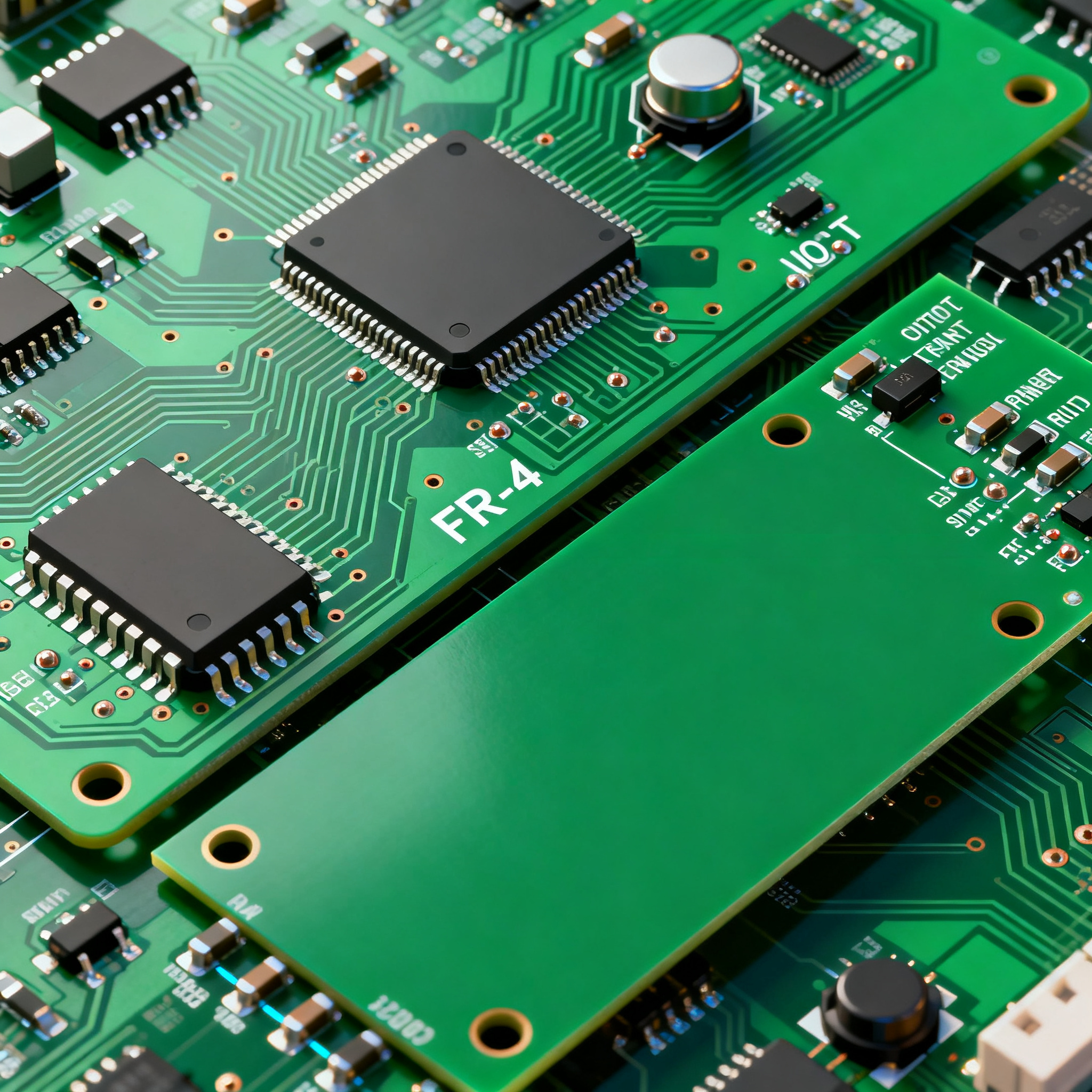
IoT PCB Assembly for Smart Appliances: FR-4 vs. High-Frequency Laminates Selection Guide
IoT PCB Assembly for Smart Appliances: FR-4 vs. High-Frequency Laminates Selection Guide When Your Smart Appliance’s RF Performance Hits the FR-4 Wall You’ve just finished integrating a Wi‑Fi 6E modul...
IoT PCB Assembly for Smart Appliances: FR-4 vs. High-Frequency Laminates Selection Guide
When Your Smart Appliance’s RF Performance Hits the FR-4 Wall
You’ve just finished integrating a Wi‑Fi 6E module into a next‑generation smart oven. The prototype works flawlessly on the bench, but after enclosure and thermal cycling, the OTA update fails halfway through. The refrigerator’s Bluetooth 5.4 connection to the home hub drops whenever the compressor kicks in. These aren’t software bugs—they’re symptoms of a PCB material that can’t keep up with the RF demands of a modern smart appliance.
Standard FR‑4 has been the backbone of consumer electronics for decades, but as IoT appliances pack multiple radios—2.4 GHz Wi‑Fi, 5 GHz, even 6 GHz for Wi‑Fi 6E, plus Bluetooth and Matter/Thread—the dielectric properties of the substrate start to dominate signal integrity. At these frequencies, every millimeter of trace becomes a transmission line, and the loss tangent of the laminate directly eats into your link budget. The result: reduced range, intermittent connectivity, and failed compliance pre‑scans that delay product launches.
The industry’s answer isn’t to abandon FR‑4 entirely but to understand exactly where it falls short and when to introduce high‑frequency laminates. A PCBSync overview of IoT PCB design notes that a common approach is using hybrid stackups—FR‑4 for digital and power sections, with a low‑loss material like Rogers for the RF layer. Meanwhile, PCBONLINE’s analysis of IoT electronics assembly highlights that ceramic‑filled hydrocarbon materials such as Rogers RO4000 series can be processed using standard FR‑4 multilayer techniques while delivering a dissipation factor below 0.00037, a figure that makes a tangible difference in antenna efficiency and signal clarity.
This guide walks you through the material selection decision that every smart appliance design team faces: when to stick with cost‑optimized FR‑4, when to move to a high‑frequency laminate, and how to specify a hybrid stackup that balances performance and BOM cost. We’ll ground each recommendation in real datasheet parameters, fabrication realities, and the procurement questions that come up when you’re ordering 10,000 boards for a connected dishwasher.
The Dielectric Constant and Loss Tangent Behind Every IoT Antenna
To make an informed choice, you need to look past the marketing names and focus on three material parameters that dictate how your PCB handles RF energy: dielectric constant (Dk), dissipation factor (Df), and glass transition temperature (Tg). For smart appliances that combine high‑speed digital, power management, and multiple antennas on a single board, these numbers translate directly into antenna gain, impedance control tolerance, and long‑term reliability under the heat of a self‑cleaning oven or a compressor motor.
Dk (εr) determines the velocity of propagation and the physical width of a 50‑Ω microstrip line. A laminate with a tightly controlled Dk—both across the panel and over temperature—lets you hit your target impedance with less tuning. FR‑4 typically has a Dk around 4.2–4.6 at 1 GHz, but the value can wander by ±0.2 from batch to batch. High‑frequency laminates like Rogers RO4350B offer a Dk of 3.48 ±0.05, which shrinks line widths but gives you repeatable impedance run after run.
Df (loss tangent) is the parameter that directly converts RF power into heat. Every dB lost in the substrate is a dB you can’t use for range. Standard FR‑4 exhibits a Df of 0.015–0.025 at 1 GHz, and that number climbs with frequency. For a 5 GHz Wi‑Fi antenna feed that’s 50 mm long, the insertion loss difference between FR‑4 and a low‑loss laminate can exceed 1.5 dB—enough to drop a product below regulatory emission limits or cause intermittent disconnections in a kitchen full of metal surfaces.
Tg is the temperature at which the resin transitions from a rigid glass to a softer, rubbery state. In a smart appliance, the PCB may see sustained temperatures of 105–130°C near power stages or inside a sealed enclosure. Standard FR‑4 with a Tg of 130–140°C leaves little headroom; high‑Tg FR‑4 (170–180°C) or a hydrocarbon‑ceramic laminate with a Tg above 280°C provides the thermal margin needed for lead‑free assembly and years of thermal cycling.
The table below compares the key electrical and thermal properties of four laminate families commonly considered for IoT appliance PCBs. The data draws on the ApolloPCB FR‑4 datasheet, the PCBSync FR‑4 material guide, and manufacturer specifications for Rogers and PTFE materials.
| Parameter | Standard FR‑4 | High‑Tg FR‑4 | Rogers RO4350B | PTFE (e.g., RT/duroid 5880) |
|---|---|---|---|---|
| Dk @ 1 GHz | 4.2–4.6 | 4.0–4.4 | 3.48 ±0.05 | 2.20 ±0.02 |
| Df @ 1 GHz | 0.015–0.025 | 0.012–0.018 | 0.0037 | 0.0004–0.0009 |
| Tg (°C) | 130–140 | 170–180 | >280 (Td) | N/A (softens) |
| CTE x‑y (ppm/°C) | 14–16 | 12–14 | 10–12 | 20–24 (depends on filler) |
| Moisture absorption (%) | 0.1–0.2 | 0.1–0.15 | 0.06 | <0.02 |
| Typical thickness range (mil) | 4–120 | 4–120 | 4–60 | 5–60 |
| Relative raw material cost | 1× | 1.2–1.5× | 5–8× | 10–20× |
The numbers tell a clear story. If your smart appliance operates exclusively at sub‑1 GHz frequencies—Zigbee, Z‑Wave, or LoRa for long‑range sensor networks—standard or high‑Tg FR‑4 may be perfectly adequate, provided you keep RF traces short and control impedance through careful stackup design. The JLCPCB FR‑4 deep guide reinforces this point: FR‑4 is ideal for cost‑sensitive designs but should be avoided for high‑power RF or circuits where insertion loss must stay below 0.5 dB. Once you move to 2.4 GHz and especially 5 GHz or 6 GHz, the Df of FR‑4 becomes the dominant loss mechanism, and a low‑loss laminate starts to pay for itself in antenna performance and manufacturing yield.
FR‑4 vs. Rogers vs. PTFE: A Cost‑Performance Map for Smart Appliance PCBs
Choosing a laminate isn’t a simple “better” or “worse” decision—it’s a trade‑off among electrical performance, fabrication complexity, and total landed cost. The table below maps the three primary material families against the realities of IoT appliance PCB assembly, from a simple temperature sensor board to a multi‑radio gateway with integrated antennas.
| Material Family | Relative Cost (Raw + Fab) | Df @ 10 GHz (typical) | Fabrication Complexity | Best Smart Appliance Use Case |
|---|---|---|---|---|
| Standard FR‑4 | 1× | 0.020–0.030 | Low – standard processes | Sub‑1 GHz sensor nodes, simple control boards with no RF |
| High‑Tg FR‑4 | 1.3–1.8× | 0.015–0.022 | Low – same as FR‑4 | 2.4 GHz Wi‑Fi/Bluetooth with short antenna feeds (<15 mm), cost‑sensitive appliances |
| Rogers RO4000 series | 3–5× | 0.0037 | Medium – compatible with FR‑4 processes, requires optimized drilling | 5 GHz Wi‑Fi, Wi‑Fi 6E, multi‑antenna MIMO, hybrid stackup RF layers |
| PTFE (Teflon‑based) | 6–12× | 0.0009 | High – special surface treatment, dimensional instability, difficult to plate | Millimeter‑wave radar sensors, high‑end ovens with 60 GHz presence detection |
| Hybrid Stackup (FR‑4 + Rogers) | 2–4× vs. pure FR‑4 | Depends on RF layer | Medium‑High – requires mixed‑material lamination expertise | Smart refrigerators, washing machines, voice‑assistant hubs with digital + RF sections |
Rogers RO4000 materials occupy a sweet spot for many smart appliances. As PCBONLINE points out, these ceramic‑filled hydrocarbon laminates can be manufactured using standard FR‑4 multilayer processes, which keeps fabrication costs in check while delivering a Df below 0.00037. That’s an order of magnitude better than FR‑4, and it directly improves antenna efficiency and reduces crosstalk in dense RF layouts.
PTFE, on the other hand, offers the ultimate low‑loss performance but comes with significant processing headaches. PCBSync notes that PTFE is more difficult to process and more expensive, which is why it’s rarely used for entire boards in consumer appliances. Instead, it appears in specialized modules or as a thin RF layer in a hybrid stackup where the application demands millimeter‑wave performance.
Cost is always a concern, but the raw material price tag doesn’t tell the whole story. FR4PCB.TECH’s low‑volume PCB material selection analysis found that optimized laser drilling parameters for high‑frequency materials can reduce fabrication time and cost by 20% compared to generic manufacturers. That’s a meaningful saving when you’re prototyping a new smart appliance or running a pilot build of 500 units. For production volumes, the same principle applies: a fabricator with dedicated high‑frequency material experience will give you better yields and shorter lead times, offsetting some of the laminate premium.
When you’re ready to move from material selection to assembly, a service that understands IoT‑specific requirements becomes critical. FR4PCB.TECH’s IoT & Smart Home PCB assembly service, for example, supports 01005 components, Wi‑Fi 6E and Bluetooth 5.4 protocols, and ultra‑low‑power design—exactly the mix you’ll find in a modern smart speaker or home automation hub. Whether you choose that partner or another, the key is to verify that the assembly house has experience with the laminate you’ve specified and can handle the fine‑pitch RF components and impedance‑controlled traces that your design demands.
How to Specify a Hybrid Stackup Without Blowing the BOM
For most smart appliances, a pure high‑frequency board is overkill, and a pure FR‑4 board is a performance risk. The hybrid stackup—one or two RF layers of Rogers or similar low‑loss material bonded to FR‑4 cores for digital and power—gives you the best of both worlds. But it also introduces new design and sourcing challenges that can trip up even experienced teams.
When to go hybrid. The decision usually comes down to the length of your RF traces and the number of antennas. If your Wi‑Fi antenna feed is under 10 mm and you’re only running a single 2.4 GHz radio, a well‑designed high‑Tg FR‑4 board with tight impedance control can work. But if you’re routing multiple 5 GHz or 6 GHz feeds across a 150 mm board—common in a smart refrigerator with a door‑mounted display and internal cameras—the cumulative insertion loss on FR‑4 will degrade throughput and range. That’s the point where a hybrid stackup pays for itself by avoiding costly redesigns and field returns.
CTE mismatch is the hidden killer. FR‑4 and Rogers laminates expand at different rates when heated. During reflow soldering and the appliance’s daily thermal cycles, that mismatch can cause delamination or barrel cracking in plated through‑holes that cross material boundaries. The ApolloPCB FR‑4 selection guide provides detailed CTE data that you can compare against your chosen high‑frequency laminate. As a rule of thumb, keep the CTE difference in the x‑y plane below 6 ppm/°C, and work with your fabricator to select a bonding prepreg that accommodates both materials. A cross‑sectional analysis after thermal cycling is non‑negotiable for the first article inspection.
Layer stack design rules. Place the RF layer on the outer surface whenever possible to minimize via transitions. If you must bury it, use a symmetrical stackup to prevent warpage. Specify the exact laminate type and thickness for each layer, not just “Rogers” or “low‑loss.” For example, “Layer 1: Rogers RO4350B 10 mil, bonded to FR‑4 core with 2× 2116 prepreg” gives the fabricator a clear recipe. Always request impedance test coupons on the production panel, and ask for TDR (time‑domain reflectometry) data to verify that your 50‑Ω lines are within ±10%.
Sourcing and assembly tips. Not every PCB shop has experience with mixed‑material lamination. Ask potential suppliers how many hybrid stackup orders they’ve processed in the last quarter and whether they stock your chosen laminate in the thickness you need. The JLCPCB FR‑4 guide’s checklist for cost‑sensitive designs is a good starting point, but for hybrid boards you’ll want a fabricator that offers dedicated RF process control. On the assembly side, look for a partner that understands IoT‑specific requirements: ultra‑low‑power design, fine‑pitch components down to 01005, and protocols like Wi‑Fi 6E and Bluetooth 5.4. At NovaPCBA, we routinely support hybrid stackup assemblies for smart appliance customers, with in‑house impedance testing and RF pre‑compliance scanning to catch issues before they reach the certification lab.
The table below provides a quick decision matrix for selecting the right stackup approach based on your appliance’s frequency, complexity, and cost targets.
| Application Scenario | Operating Frequency | Key Requirements | Recommended Stackup | Notes |
|---|---|---|---|---|
| Simple sensor (temperature, door open/close) | Sub‑1 GHz (Zigbee, Z‑Wave) | Lowest cost, single radio | Standard FR‑4, 2‑layer | Keep RF trace under 20 mm; no impedance control needed |
| Voice‑assistant smart speaker | 2.4 GHz Wi‑Fi + Bluetooth | Moderate cost, dual radio, compact layout | High‑Tg FR‑4, 4‑layer | Use ground plane for impedance control; verify Df at 2.4 GHz |
| Smart refrigerator with display & cameras | 5 GHz Wi‑Fi, Wi‑Fi 6E, BLE | Multiple antennas, long RF traces, thermal cycling | Hybrid: Rogers RO4350B (RF) + FR‑4 (digital/power) | CTE matching critical; request cross‑sectional analysis |
| High‑end oven with presence detection | 60 GHz radar, Wi‑Fi 6E | Millimeter‑wave performance, high‑temp reliability | Hybrid with PTFE RF layer or all‑Rogers RO3000 | PTFE requires specialized fabrication; budget for longer lead time |
| Cost‑optimized smart plug / light switch | 2.4 GHz Wi‑Fi | Ultra‑low BOM, single antenna, short range | Standard FR‑4 with careful layout | Use chip antenna with matching network; test in enclosure |
What Procurement Teams Ask Before Signing Off on High‑Frequency Laminates
When the engineering team proposes moving from FR‑4 to a Rogers or PTFE laminate, procurement and management have legitimate questions. Here are the ones that come up in every smart appliance program, answered with the specificity you need to build a business case.
Q: At what frequency does FR‑4 become a liability in smart appliance designs?
FR‑4’s loss tangent rises sharply above 1 GHz. At 2.4 GHz, the insertion loss on a typical 50‑mm microstrip can reach 0.8–1.2 dB, which is manageable for short antenna feeds. But at 5 GHz and especially 6 GHz (Wi‑Fi 6E), that same trace can lose 2 dB or more, and impedance variations due to Dk tolerance become harder to tune out. Many teams switch to a low‑loss laminate once the RF path exceeds 15–20 mm or when antenna efficiency is critical for passing regulatory radiated power tests. If your appliance relies on OTA firmware updates or real‑time video streaming, the margin gained by a low‑Df material can be the difference between a reliable connection and a customer complaint.
Q: Can I mix Rogers 4350B and FR‑4 in the same stackup without delamination?
Yes, hybrid stackups are common and proven, but they require careful CTE matching and a bonding prepreg compatible with both materials. The x‑y CTE of Rogers RO4350B is around 10–12 ppm/°C, while high‑Tg FR‑4 is 12–14 ppm/°C—close enough for most consumer appliance thermal cycles. The risk lies in the z‑axis expansion, which can stress plated through‑holes. Work with a fabricator that has documented mixed‑material lamination processes and can provide cross‑sectional analysis after 500–1,000 thermal cycles (−40 to +125°C) to verify reliability. Don’t skip this step; field failures in a sealed appliance are expensive to fix.
Q: How much more does a high‑frequency laminate add to the BOM cost per square inch?
Rogers RO4000 series raw material is typically 5–10× the cost of standard FR‑4 per square foot. However, the total PCB cost increase is often 2–4× when you factor in fabrication, because the material is only part of the board. PTFE can push the multiplier to 6–12×. For low‑volume runs, the fabrication premium can be higher, but techniques like optimized laser drilling—as highlighted by FR4PCB.TECH—can reduce fabrication time and cost by about 20% compared to generic manufacturers. Always get quotes that separate material and processing costs so you can see exactly where the premium lies.
Q: What certifications should I look for in an IoT PCB assembly partner for smart appliances?
At a minimum, look for IPC‑A‑610 Class 2 or Class 3 acceptability, which ensures solder joint quality appropriate for consumer or high‑reliability environments. The laminates themselves should carry UL recognition, and the assembly partner should be able to provide certificates of conformance for RoHS and REACH if you’re selling in Europe. For RF‑heavy designs, ask whether the partner offers impedance TDR measurements and VNA (vector network analyzer) testing on production panels. Some assembly houses also provide wireless pre‑compliance scanning for FCC/CE, which can save weeks in the certification cycle. If your appliance uses Matter or Thread, confirm that the partner has experience with the specific module footprints and antenna keep‑out zones those protocols demand.
Q: Is there a lead time difference between FR‑4 and Rogers‑based PCBs?
Yes. Rogers and other high‑frequency laminates typically add 3–7 working days to standard lead times. This comes from material availability—not all distributors stock every Rogers thickness and copper weight—and from the more complex drilling and plating processes required. Some fabricators keep popular Rogers types (RO4350B 10 mil and 20 mil) in inventory to mitigate this, but you should always confirm current stock before committing to a production schedule. For PTFE, the lead time extension can be 7–10 days or more. In a fast‑moving consumer appliance program, that extra week can impact your launch date, so involve your PCB supplier early in the design phase to reserve material and slot capacity.
Selecting the right laminate for a smart appliance PCB is a decision that ripples through RF performance, manufacturing yield, BOM cost, and supply chain agility. By understanding the dielectric fundamentals, mapping material options against your specific frequency and layout requirements, and engaging a fabrication and assembly partner with proven IoT experience, you can avoid the FR‑4 wall without overspending on exotic materials. Whether you’re building a million‑unit smart plug or a flagship connected oven, the principles in this guide will help you make a choice that balances performance and practicality. For teams ready to move into production, NovaPCBA offers end‑to‑end support for hybrid stackup assembly, RF impedance testing, and IoT‑specific process control—so your boards perform as well in the field as they do on the bench.
References & Further Reading
- Low-Volume PCB Material Selection: Cost Comparison Between FR-4 and High-Frequency Materials – FR4PCB.TECH
- IoT & Smart Home PCB Assembly Services – FR4PCB.TECH
- IoT PCB: Everything You Need to Know (Design, Materials & Best Practices) – PCBSync
- PCB Assembly for IoT Electronics – PCBONLINE
- FR4 PCB Material Specification Sheet (PDF) | 2026 Technical Selection Guide – ApolloPCB
- FR-4 PCB Material Guide: The