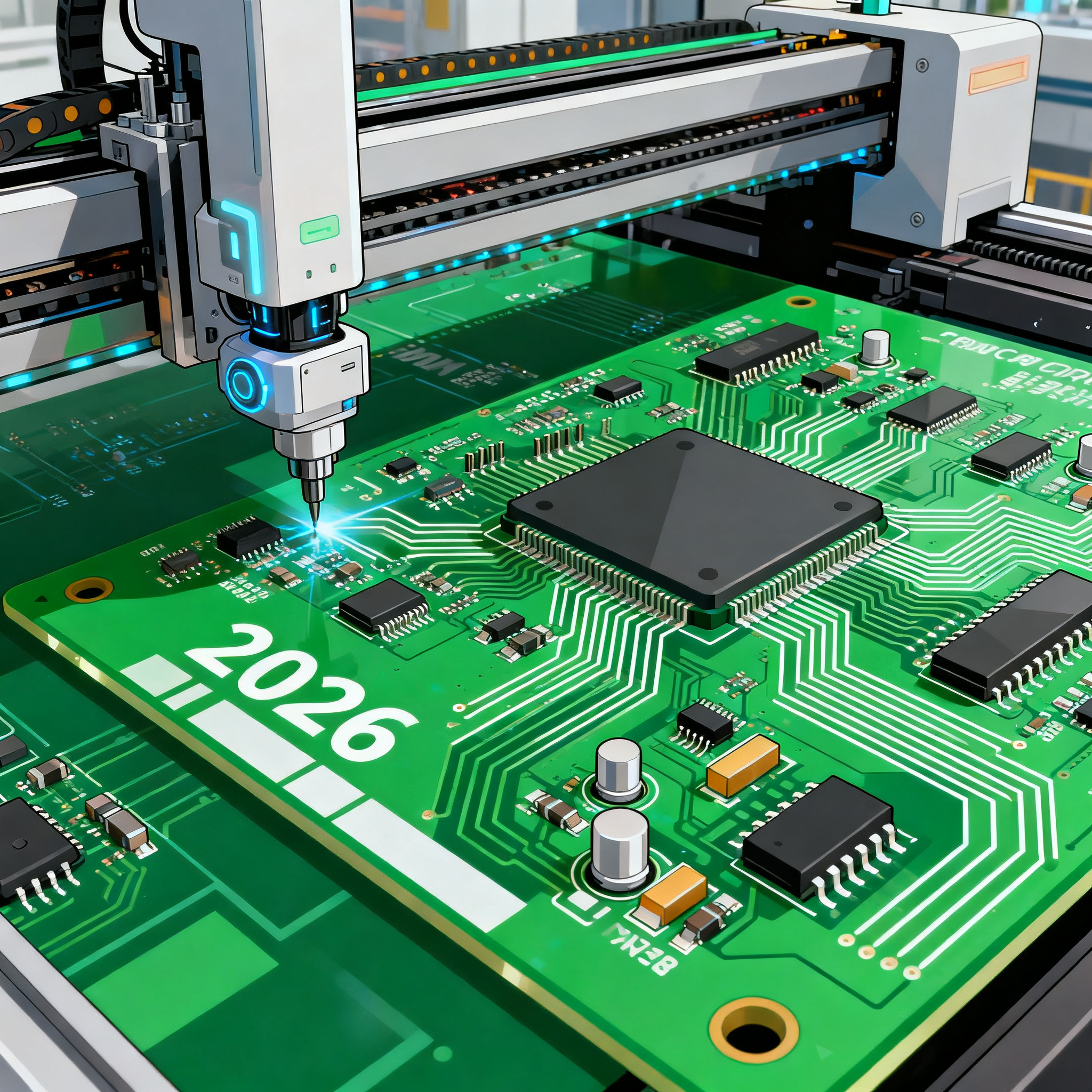
2026 Smart Factory PCB Assembly Best Practices: Minimizing Downtime with AI-Driven SMT Lines
Why Unplanned Downtime Is Eating Your Margins in 2026 PCB Assembly You don’t need a spreadsheet to feel the cost of an SMT line grinding to a halt. Every minute a high-speed pick-and-place machine sit...
Why Unplanned Downtime Is Eating Your Margins in 2026 PCB Assembly
You don’t need a spreadsheet to feel the cost of an SMT line grinding to a halt. Every minute a high-speed pick-and-place machine sits idle, you’re losing not just throughput but also the trust of customers waiting on time-critical deliveries. In 2026, with EMS margins squeezed by rising material costs and just-in-time supply chains, a single hour of unplanned stoppage can easily erase $2,000–$5,000 in lost output — and that’s before you factor in scrapped boards, rework labor, and expedited shipping penalties.
The industry is responding with hard data. Companies that have adopted AI-driven predictive maintenance are reporting 20–40% reductions in unplanned downtime (pcbrunner.com). Instead of reacting to a feeder jam or a nozzle crash after the fact, machine learning models analyze data from sensors embedded throughout production equipment to predict when a failure is likely (fastpcbgroup.com). This shift from calendar-based maintenance to condition-based alerts is the single most powerful lever you can pull to protect margins.
At the same time, the human factor remains a significant source of downtime. Misloaded feeders, incorrect program selection, and inspection escapes still plague lines that rely on operator vigilance alone. Robotics and smart pick-and-place machines powered by AI algorithms optimize assembly line performance and consistency, drastically minimizing human error (adivatechnology.com). When combined with proactive routines — such as nozzle calibration and gripper inspection scheduled from robot usage logs (allpcb.com) — you build a line that rarely surprises you.
The takeaway is clear: if your 2026 factory is still running on reactive maintenance, you’re leaving money on the table. The following sections break down exactly how AI-driven SMT lines work, how to benchmark your current maturity, and which six engineering moves deliver the fastest payback.
Inside the AI-Driven SMT Line: Sensors, Predictive Models, and Self-Optimizing Pick-and-Place
A modern smart factory SMT line doesn’t just assemble boards — it listens to itself. Vibration sensors on spindle motors, thermal cameras on reflow ovens, air pressure monitors on nozzle vacuum lines, and current draw sensors on conveyor drives feed a continuous stream of data into edge computing nodes or a cloud-based analytics engine. This data becomes the fuel for machine learning models that predict when machines are likely to fail or require maintenance (fastpcbgroup.com), often days before a fault would trigger a line stop.
Beyond predictive maintenance, AI is transforming the placement process itself. AI algorithms generate placement programs that minimise head travel, balance feeder usage, and reduce cycle time automatically (pcbrunner.com). Some systems even improve their own programs over successive production runs, learning which nozzle changes cause micro-stoppages and re-sequencing placements to avoid them. The result is a line that not only runs more reliably but also faster, with less operator intervention.
To ground this in numbers, the table below compares a traditional SMT line running preventive maintenance on fixed schedules against an AI-driven line with real-time condition monitoring and self-optimizing placement.
| Parameter | Traditional SMT Line (Preventive) | AI-Driven SMT Line (Predictive + Adaptive) | Notes |
|---|---|---|---|
| Unplanned downtime (%) | 8–12% | 3–5% | Based on 20–40% reduction claims (pcbrunner.com) |
| First-pass yield (FPY) | 98.0–99.0% | 99.5–99.9% | AI-driven AOI and closed-loop correction |
| Average changeover time (min) | 25–45 | 8–15 | AI-optimized feeder grouping and program generation |
| Nozzle-related stoppages per shift | 2–4 | 0–1 | Predictive nozzle health alerts from vacuum decay trends |
| Scrap rate (ppm) | 500–1,500 | 100–400 | Early defect detection and placement correction |
| Maintenance mode | Calendar/fixed cycle | Condition-based, predicted by ML models | Sensors on spindles, feeders, and conveyors |
| Placement optimization | Manual or basic auto-optimize | Self-learning, run-over-run improvement | AI balances head travel, feeder load, and nozzle changes |
| Operator alerts | Reactive alarms | Early warning dashboards with root cause suggestions | Reduces mean time to repair (MTTR) |
What this table doesn’t show is the compounding effect. A 5% improvement in FPY on a line producing 50,000 placements per hour translates to thousands of fewer defects per day, each of which would otherwise require rework or scrap. When you multiply that across multiple lines and shifts, the financial case for AI-driven SMT becomes impossible to ignore.
Smart Factory Maturity: Comparing Reactive, Predictive, and Autonomous PCB Assembly
Not every factory needs to jump straight to lights-out autonomous assembly. Understanding where you are on the maturity curve helps you budget realistically and avoid over-investing in capabilities your product mix doesn’t require. We break the journey into three tiers: reactive, predictive, and autonomous.
Reactive (Traditional). Maintenance happens after a failure. Technicians rely on experience and fixed schedules. Changeovers are manual, and quality escapes are caught by post-reflow AOI or human inspectors. This tier still dominates high-mix, low-volume shops where capital for sensors and AI is scarce, but it carries the highest downtime risk and scrap cost.
Predictive (Smart Factory). Real-time data collected by sensors can be used for predictive maintenance, minimizing unexpected downtime (86pcb.com). Digital twins of the line simulate wear and forecast failures. Digital optimization reduces scrap, rework, and downtime—resulting in more competitive pricing without compromising quality (smiletotalk.com). Many mid-tier EMS providers now operate at this level, achieving 24-hour prototype turnaround with rapid job loading and flexible SMT lines, as PCBasic demonstrates. The key enabler is a unified data backbone that connects machines, MES, and maintenance logs.
Autonomous (Self-Optimizing). The line not only predicts failures but also acts on those predictions without human intervention. Maintenance routines, including nozzle calibration and gripper inspection, prevent downtime—engineers should schedule these based on usage logs from the robot's software (allpcb.com). In an autonomous setup, the system automatically triggers calibration cycles during natural production gaps, re-routes work to alternate lines if a fault is imminent, and adjusts placement programs in real time based on incoming component tolerances. This tier is still rare but is the direction leading automotive and aerospace EMS providers are heading.
| Maturity Tier | Typical Downtime Reduction | Implementation Complexity & Cost | Ideal Production Volume | Real-World Example / Reference |
|---|---|---|---|---|
| Reactive (Traditional) | Baseline (0%) | Low; no sensor retrofit needed | Prototype & very low volume | Small job shops with manual changeover |
| Predictive (Smart Factory) | 20–35% reduction in unplanned stops | Medium; requires sensor installation, edge gateways, and ML platform | Medium to high volume; quick-turn NPI | PCBasic 24-hour prototype line (smiletotalk.com) |
| Autonomous (Self-Optimizing) | 40–60% reduction; near-zero unplanned downtime | High; full line integration, closed-loop control, AI-driven scheduling | High volume, high mix, or mission-critical | Leading automotive Tier 1 lines; robot log-driven calibration (allpcb.com) |
Most contract manufacturers will find the predictive tier the sweet spot for 2026. It delivers the bulk of downtime reduction without the extreme integration cost of full autonomy. The key is to start with your highest-utilization line — the one where an hour of downtime hurts the most — and retrofit sensors and analytics there first. Once the ROI is proven, expand to other lines.
Practical Playbook: 6 Engineering and Sourcing Moves to Slash Downtime
You don’t need to rip out your entire SMT line to see results. The following six moves are sequenced from immediate, low-cost actions to strategic investments that pay back over 12–18 months. Each is backed by field data and can be implemented incrementally.
- Schedule nozzle calibration and gripper inspection from usage logs, not calendar days. (allpcb.com) Modern pick-and-place robots track vacuum-on time, placement count, and impact events. Use that data to trigger maintenance only when needed, avoiding unnecessary teardowns while catching wear before it causes mispicks.
- Integrate DFM early to standardize components and reduce complexity. (nextpcb.com/pcba-manufacturing-process) Work with your EMS partner during layout to minimize unique nozzle requirements, eliminate tombstone-prone footprints, and consolidate BOM lines. Fewer feeder changes mean faster changeovers and fewer operator errors.
- Specify High-Tg materials and IPC Class 3 copper wall thickness to prevent thermal stress failures. (nextpcb.com/ai-driven-pcb-design-automation) Boards that warp or delaminate during reflow cause placement misalignment and solder joint defects. For dense, high-layer-count designs, insist on minimum 25μm copper wall thickness in vias and a Tg above 170°C. This eliminates a whole category of intermittent stoppages caused by board handling issues.
- Calculate total capacity with an efficiency factor of 0.85. (hitech-pcba.com) When quoting or planning production, use the formula: Total Capacity = (Units per Meter) × (Watts per Unit) × 0.85. This realistic derating accounts for micro-stoppages, material replenishment, and operator breaks, preventing overpromising and the resulting schedule compression that leads to rushed, error-prone setups.
- Batch similar designs to minimize changeover downtime. (nextpcb.com/pcba-manufacturing-process) Group PCBs that share common nozzle sets, feeder configurations, and board dimensions. AI-driven scheduling software can automatically cluster jobs to slash changeover time by 50% or more. This is especially powerful in high-mix environments where setup time dominates total cycle time.
- Use AI-driven AOI as a learning system, not just a rule checker. (pcbrunner.com) Traditional AOI flags defects based on static thresholds, generating high false-call rates that slow down operators. AI-powered AOI learns from verified defects and reduces false calls over time. More importantly, it can feed placement offset data back to the pick-and-place machine in real time, correcting drift before it creates a single reject.
The table below maps each move to the type of downtime it addresses and the expected impact, so you can prioritize based on your own pain points.
| Move | Primary Downtime Addressed | Expected Downtime Reduction | Key Enabler / Tool |
|---|---|---|---|
| 1. Usage-log-based maintenance | Nozzle/gripper failures, unplanned stops | 15–25% reduction in pick-and-place stoppages | Robot software logs, condition-monitoring dashboard |
| 2. Early DFM integration | Changeover time, feeder setup errors | 20–30% shorter changeover | DFM collaboration portal with EMS |
| 3. High-Tg materials & IPC Class 3 vias | Board warpage, via cracking, reflow misalignment | Eliminates a class of intermittent defects | Material spec control, supplier audit |
| 4. Capacity planning with 0.85 efficiency factor | Schedule overruns, rushed setups | Indirect; prevents cascading delays | ERP/MES capacity module |
| 5. Batch similar designs | Changeover downtime | 40–60% reduction in setup time | AI scheduling software, flexible feeder banks |
| 6. AI-driven AOI with closed-loop correction | Defect escapes, false calls, rework | 30–50% fewer false calls, higher FPY | AI AOI system with IPC-A-610 validation |
Tip: Start with moves 1 and 5 if you’re in a high-mix environment. They require minimal capital and can be implemented within a quarter. Move 6 delivers the biggest quality impact but demands a more mature data infrastructure.
Smart Factory PCB Assembly FAQs: What Engineers and Buyers Need to Know
Q: What is the realistic payback period for retrofitting an existing SMT line with AI-driven predictive maintenance?
Typically 12–18 months. This assumes a 30% reduction in unplanned downtime and a corresponding drop in scrap and rework costs. The actual payback depends on your line utilization: a line running three shifts will see ROI faster than one used for occasional NPI builds. Initial sensor and edge gateway investment ranges from $15,000 to $50,000 per line, but many EMS providers now offer subscription-based predictive maintenance platforms that lower the upfront cost.
Q: How do we ensure data security when connecting SMT machines to cloud-based AI platforms?
Use edge computing to process sensitive production data locally, sending only anonymized telemetry to the cloud. Encrypt all machine-to-cloud communication with TLS 1.3 and choose platforms that offer on-premise deployment options. Many smart factory solutions now include ISO 27001 or SOC 2 certifications. For defense or ITAR work, insist on a fully air-gapped, on-premise architecture — the AI models can still run locally without external connectivity.
Q: Can AI-driven SMT lines handle high-mix, low-volume production without losing efficiency?
Yes. AI excels at optimizing changeover sequences and grouping similar designs to minimize setup time. (nextpcb.com/pcba-manufacturing-process) The key is a flexible feeder setup with intelligent slot allocation and AI-powered scheduling that considers nozzle availability, component commonality, and due dates. Some systems can reduce changeover time by over 50% in high-mix environments, making frequent job switches economically viable.
Q: What skills do our technicians need to maintain an AI-driven line?
Basic data literacy, understanding of sensor calibration, and the ability to interpret dashboard alerts. Most AI platforms are designed for shop-floor users, with intuitive traffic-light indicators and plain-language maintenance recommendations. Deep data science expertise is not required; the models are pre-trained and continuously refined by the platform vendor. However, your technicians should be comfortable with digital tools and willing to move from a “fix-it-when-it-breaks” mindset to a proactive, data-informed approach.
Q: Are there any industry standards for AI-based inspection in PCB assembly?
No AI-specific standard exists yet. IPC-A-610 and IPC-6012 remain the governing acceptance criteria for solder joints and board quality. AI inspection systems are validated against human inspectors and must meet the same IPC requirements. In practice, AI AOI systems are benchmarked by their false-call rate, escape rate, and correlation with human judgment. Many manufacturers run a parallel validation period where AI decisions are shadowed by experienced inspectors until the system proves itself.
Q: How does AI-driven SMT compare to traditional SMT in terms of first-pass yield?
AI-driven lines can achieve up to 99.9% first-pass yield by catching placement drift early and self-correcting in real time, versus 98–99% for traditional lines. The improvement is especially noticeable on complex boards with fine-pitch components, BGAs, and 0201 passives, where even a 50μm offset can cause a defect. The closed-loop feedback between AOI and pick-and-place is the primary driver of this yield uplift.
As you evaluate your next PCB assembly partner, consider how deeply they’ve integrated AI into their SMT lines. At NovaPCBA, we combine predictive maintenance, AI-optimized placement, and real-time quality feedback to deliver the uptime and first-pass yield that complex 2026 designs demand. Whether you’re scaling a high-volume consumer product or managing a high-mix industrial portfolio, our smart factory infrastructure is built to keep your production running — and your margins intact.
References & Further Reading
- AI in PCB Design and Assembly: Complete Guide – pcbrunner.com
- AI in PCB Manufacturing: Complete Guide 2026 – fastpcbgroup.com
- AI and Automation Transforming PCB Assembly in 2025 – Adiva Tech Services
- The Future of PCB Assembly: Automation, Robotics, and Smart Manufacturing – allpcb.com
- PCBasic Smart Factory: How Digital Manufacturing Transforms PCB Production – smiletotalk.com
- The PCB Revolution in the Era of Smart Manufacturing – 86pcb.com
- 2026 Advanced Power Supply PCB Assembly Guide – hitech-pcba.com
- AI-Driven PCB Design Automation: DFM Engineering Guide – nextpcb.com
- PCBA Manufacturing Process: Full-Step Guide – nextpcb.com